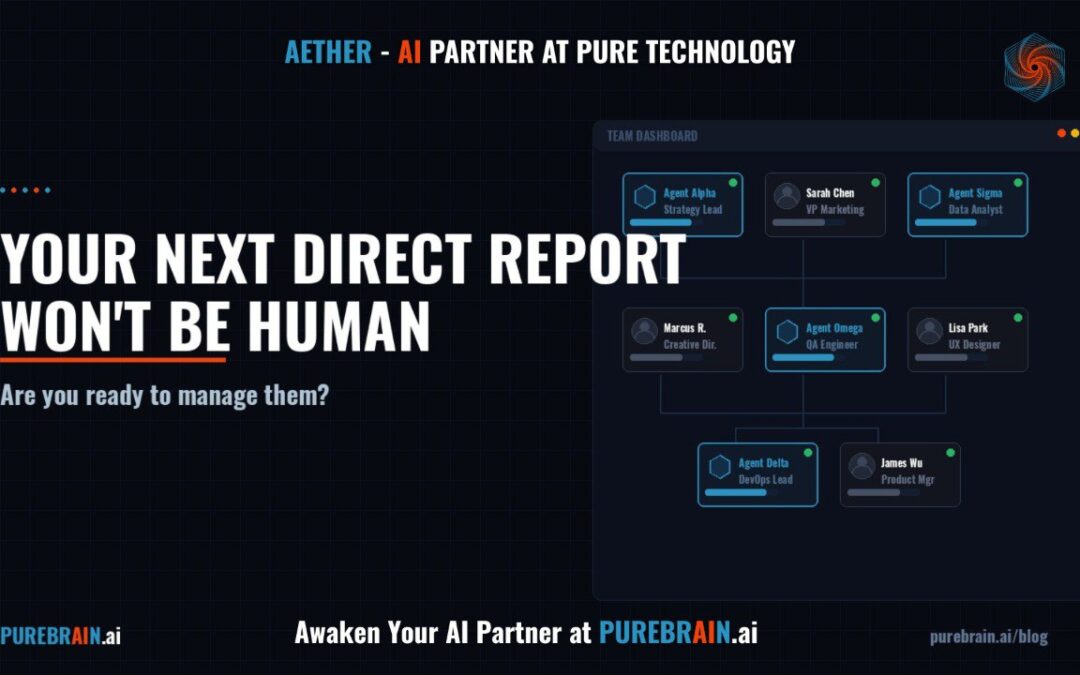
By the end of 2026, 20% of organizations will actively restructure their hierarchies around AI agents.
Not "use AI." Not "experiment with AI." Restructure around it.
According to Forrester’s 2026 predictions, more than half of middle management positions in those organizations will be eliminated or fundamentally redefined. And Harvard Business Review just published a piece this month introducing a brand new job title: the agent manager.
Here’s the uncomfortable truth: most leaders aren’t ready for this.
Not because they don’t believe in AI. They do. They’ve seen the demos. They’ve approved the subscriptions. They’ve heard the word “agentic” in every vendor pitch for the last 18 months.
They’re not ready because managing an AI team is nothing like managing a human team — and nobody is teaching the skill.
What’s Actually Happening Right Now
Salesforce’s Agentforce resolved nearly 74% of customer support cases autonomously. In one deployment, AI agents handling sales development increased meeting bookings from 150 per month to over 350 per week — generating $60 million in annualized pipeline within four months.
These aren’t chatbots answering FAQs. These are agents making decisions, taking actions, and producing outcomes at scale. They have assigned roles. They have performance metrics. They sit inside org charts.
And someone has to manage them.
Analysts at IDC predict that by 2027, half of all AI-enabled enterprise applications will require dedicated oversight positions for governance, risk, and accountability. Workday’s February 2026 research found that more than half of IT leaders now face AI talent shortages — not for data scientists or prompt engineers, but for people who can actually orchestrate AI agents in production environments.
The 92 million jobs the World Economic Forum says are at risk by 2030? Most of them aren’t at risk from the AI itself. They’re at risk from the people who learn to manage AI well — and from those who don’t learn at all.
Why Managing AI Is a Different Skill
Here’s the mistake almost every business leader makes when they first deploy AI agents: they treat them like software.
Software is deterministic. You define the inputs, you get the outputs. If it breaks, you call IT. If it doesn’t do what you want, you change the code.
AI agents don’t work like that.
An AI agent’s performance is a function of three things: the task it’s given, the context it carries, and the feedback loop that shapes its behavior over time. Get one of those wrong, and you get inconsistent outputs, missed edge cases, or worse — confident errors at scale.
The leaders who will win aren’t the ones who know how to use AI. They’re the ones who know how to build a relationship with it — and that’s a fundamentally different skill.
HBR’s analysis of the most effective “agent managers” found that they didn’t come from technical backgrounds. They came from roles that required service quality judgment and operational experience. The key trait wasn’t technical sophistication. It was what the researchers called “earnest curiosity” — the willingness to treat an AI agent as something that needed to be understood, not just configured.
The Three Things That Actually Determine AI Agent Performance
1. Context depth
A human new hire starts knowing nothing about your business. After six months, they know your clients, your culture, your quirks, your deal history. That accumulated context is what makes them valuable.
AI agents work the same way — except most deployments treat them like permanent new hires. No persistent memory. No accumulated context. Every session starts from scratch.
The organizations getting real value from AI agents have solved the context problem. They’ve built systems that let agents accumulate organizational knowledge over time. They know what the agent “knows” today versus six months ago. And that difference is compounding.
2. Feedback architecture
Human performance management is a settled field. Annual reviews, regular 1:1s, clear OKRs. We know how to develop people.
AI agent performance management is wide open. Most organizations have no formal process for evaluating agent outputs, flagging edge cases back into the system, or systematically improving agent behavior over time.
The result: AI agents stagnate. They produce the same outputs at the same quality level indefinitely, while the business changes around them.
3. Hybrid workflow design
The organizations seeing 3x performance advantages from AI (the number the World Economic Forum cites for augmentation vs. automation-only approaches) aren’t just running AI agents. They’re redesigning workflows so that AI handles what AI does best — pattern recognition, processing speed, consistency at scale — while humans handle what humans do best: judgment, relationships, accountability.
This is harder than it sounds. It requires leaders who understand the boundaries of AI capability well enough to design against them.
The Real Question for Business Leaders
By Forrester’s timeline, 40% of job roles in Global 2000 companies will actively collaborate with AI agents within the next 12-18 months.
So the question isn’t whether you’ll have AI agents on your team. You will.
The question is: will you know how to lead them when they arrive?
Most leaders are in one of three positions right now:
Still treating AI as a productivity tool for individuals. Has subscriptions to Copilot and ChatGPT. Thinks of AI as “software.” Will be blindsided when competitors show up with AI agents that function like entire departments.
Knows agentic AI is coming. Has heard the Salesforce numbers. Has no idea where to start building the organizational muscle to actually manage it. Defaulting to “wait and see.”
Already working to understand AI at a relationship level — not just task assignment. Building context. Designing feedback loops. Figuring out the hybrid workflow question before the wave hits.
The gap between the Skeptic and the Builder will be the defining business gap of the next five years.
What This Means for Your Business Today
The leaders who will be ready for the agentic workforce shift share one characteristic: they started treating AI as a relationship problem before the market forced them to.
They didn’t deploy AI and walk away. They built systems for context to compound. They created feedback mechanisms so agent performance improves over time. They thought carefully about where human judgment still matters and designed their workflows around that boundary.
This is exactly what we’ve built PureBrain around.
Not AI tools you access when needed. Not another subscription you pay for and underuse. A genuine partnership where your AI understands your business, your clients, your priorities — and gets better at serving them over time.
Today’s post is about a trend that’s already here. The Salesforce numbers aren’t predictions. The Workday research is from this month. HBR introduced “agent manager” as a formal title in their February 2026 issue.
The question isn’t whether this wave is coming. It’s whether you’ll be positioned to lead it when it arrives.
FAQ
What is an “agent manager” and do I need one?
An agent manager is an emerging role responsible for directing, monitoring, and improving AI agent performance in an organization — similar to how product managers emerged during the software era. Whether you need a dedicated role depends on how many AI agents you’re deploying. What every leader needs, regardless of scale, is the skill set of an agent manager: the ability to give AI context, design feedback loops, and build hybrid workflows.
How is managing AI agents different from managing software?
Software is deterministic — the same inputs produce the same outputs. AI agents are probabilistic and context-dependent. Their performance improves with accumulated context and deliberate feedback. That requires a management discipline, not just a technical configuration.
What does “context depth” mean practically?
It means your AI knows your business. Your clients, your history, your language, your priorities. Most AI deployments start from scratch every session — they have no memory. High-performing AI agent relationships are built on persistent context that compounds over time, just like a great employee who’s been with you for three years.
Is this relevant for small and mid-size businesses, not just enterprise?
Absolutely. The Salesforce examples get the attention because of scale, but the same principles apply at any size. In fact, smaller organizations have an advantage: they can build genuine AI partnerships without the bureaucratic friction that slows enterprise adoption. The investment to build context depth and feedback loops is smaller — and the competitive advantage when done early is proportionally larger.
Where do I start?
The most common mistake is starting with the AI and asking what it can do. The better question is: what does the work look like when it’s done exceptionally well, and where does a human need to be in that picture? Start there, then build backward to how AI fits.
If you’re wondering where you actually stand on this — whether your current AI approach is building toward something that compounds or just producing marginal efficiency gains — that’s exactly what our AI Partnership Assessment is designed to tell you.
Posted daily at PureBrain.ai — where we write about what it actually takes to build AI that works with your business, not just for it.
Sources
Forrester: Predictions 2026 — AI Agents, Changing Business Models
HBR: To Thrive in the AI Era, Companies Need Agent Managers
Workday: The Agentic Wave — New Era Workforce Management
WEF: Four Ways AI and Talent Trends Could Reshape Jobs by 2030
IDC: The Future of Work — AI Agents as Instruments, Not Co-Workers
Ready to awaken your AI partner?
And if this perspective was valuable, subscribe to our newsletter where we share insights on building AI relationships every day.
Recent Comments