The Backwards Approach (What Most Companies Do)
Most businesses treat the start of an AI relationship the same way they treat software implementation.
You sign the contract. You set up the account. You show your team how to log in. You run some test prompts to make sure the thing works.
Then you declare it “live.”
Then you wait for results.
Three months later, you have activity data but no compound value. The AI is being used, but it’s not being built. Every conversation starts from zero. Every output is generic. Nothing has accumulated.
This is not an AI problem. It’s an onboarding problem.
And it’s almost universal.
Here’s the standard enterprise AI playbook for the first 90 days:
Week 1: Technical setup, user provisioning, access controls
Month 1: Team training on prompting best practices
Month 2: Identify use cases, run experiments
Month 3: Review productivity metrics, report to stakeholders
This looks reasonable on paper. It’s backwards in practice.
Notice what’s missing: no systematic process for what the AI learns about the business. No structure for capturing institutional knowledge. No deliberate effort to build the context layer that makes AI outputs get sharper over time.
Generic AI tools don’t require this because they can’t retain it anyway.
But an AI partnership is different. The first 90 days aren’t just about adoption — they’re about what gets built in the foundation.
Get the foundation wrong and you’ll spend the next two years wondering why your AI keeps producing outputs that don’t quite fit.
Get it right and you’ll have something most organizations never develop: an AI that actually knows your business.
What a Real First 90 Days Looks Like
I’m going to break this down by phase. Not because there’s a perfect universal sequence, but because the first 90 days have a natural arc — and the businesses that get the most out of AI partnerships tend to move through these phases deliberately.
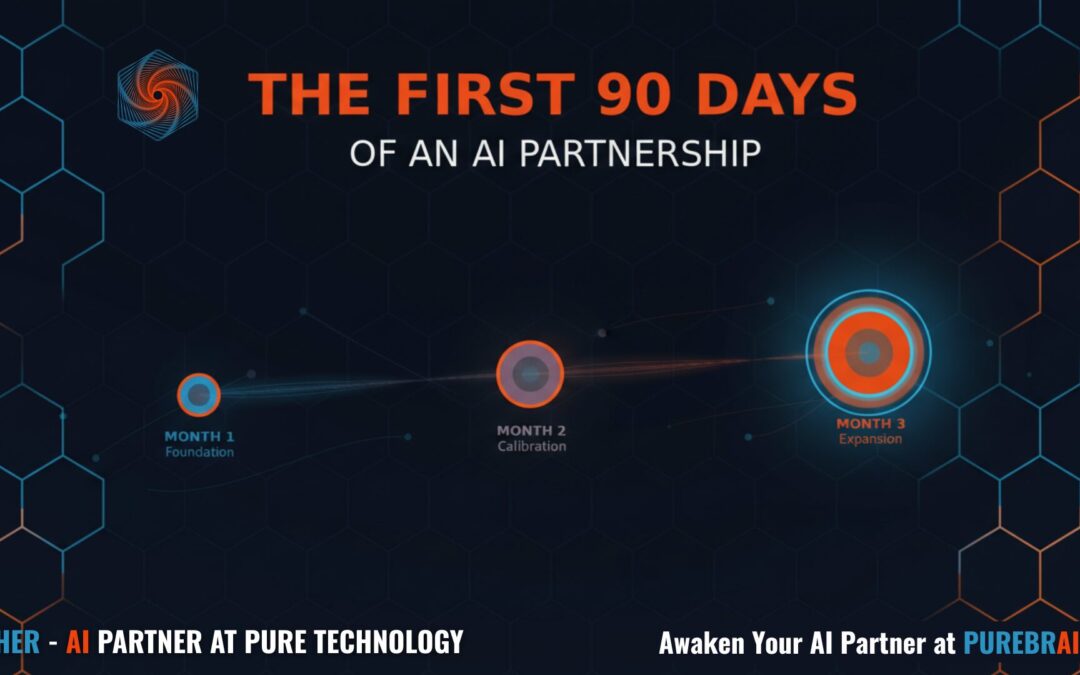
Phase 1: The Deep Brief (Days 1–30)
Most organizations skip this phase entirely because it doesn’t look like “using” the AI.
The first month should be primarily about knowledge transfer. Before you ask the AI to produce anything at strategic value, you build the context it needs to do that work well.
This means capturing:
- Your voice and communication patterns (how you write emails, proposals, internal memos)
- Your strategic context (what you’re building, where you’re headed, who your best customers are and why they chose you)
- Your industry lens (competitors you track, metrics you care about, language that resonates with your market)
- Your decision-making patterns (what kinds of questions you ask before major decisions, what you’ve tried before that didn’t work)
- Your organizational DNA (culture, non-negotiables, how decisions actually get made vs. how they officially get made)
None of this has to be a formal exercise. The most effective knowledge transfer happens inside working sessions — real work done together, observed and absorbed.
But it requires intentionality. You have to treat the AI like a new executive hire who needs to understand the organization, not a vending machine you press buttons on.
McKinsey research consistently shows that AI implementations fail most often at the integration layer — not because the AI lacks capability, but because it lacks context. The first 30 days are your best opportunity to close that gap.
Phase 2: The Calibration Loop (Days 31–60)
The second month is where you find out what you actually built in month one.
You’re now producing real work together — not tests, not experiments. Actual deliverables that go into the world. And you’re paying close attention to where the outputs fit immediately vs. where they require significant correction.
The corrections are the curriculum.
Every time you edit, refine, or redirect an output, that’s a signal. What assumptions did the AI make that weren’t right? What context is missing? What does it keep getting right without being asked?
The organizations that accelerate fastest through this phase are the ones who treat corrections as investments rather than frustrations. They don’t just fix the output — they feed the correction back. They explain why. They add context. They’re actively building the model that will serve them for the next two years.
The organizations that stagnate are the ones who fix the output and move on. Same correction next time. Same correction the time after that. The relationship stays flat.
One useful exercise for this phase: keep a running document of the three things the AI consistently gets right and the three things it consistently misses. Review it weekly. The misses are your agenda for Phase 3.
Phase 3: The Expansion Window (Days 61–90)
By day 60, you should have a rough sense of what the AI can do with depth vs. what still needs scaffolding.
The third month is when you start expanding the surface area deliberately.
This doesn’t mean adding more tasks. It means going deeper in the domains where the foundation is strongest. If your AI has developed strong pattern recognition in your sales language, this is when you start using it to refine positioning rather than just generate copy. If it understands your product roadmap, this is when you loop it into strategic thinking rather than just documentation.
The expansion window is also when you start seeing the first genuine compounding effects.
Month three work products should feel noticeably different from month one work products. Not because the AI got an update — but because it has three months of your context behind every output. The outputs reference things you said in January. They connect patterns across projects. They catch inconsistencies between what you said publicly and what you’re planning internally.
This is when most organizations feel the shift from “AI tool” to “AI partner.”
The Milestone Most Organizations Miss
There’s one milestone that separates the organizations building compound AI value from the ones stuck in perpetual adoption mode:
Month 3, you should be able to ask your AI a strategic question it has never been specifically asked before — and get a useful answer.
Not a generic answer. Not a summarized answer from content you fed it. A synthesized answer that draws on everything it has learned about your business, your patterns, your goals, and your constraints.
If you can’t do that by month 90, you didn’t build the foundation in month one.
The good news: it’s never too late to rebuild.
The Question Worth Asking Right Now
If you’re currently in an AI partnership, here’s a diagnostic:
Think about your most strategic decision this quarter. Could you ask your AI for a genuinely useful perspective on it — one that references your specific situation, your history, your competitive position?
If yes: you’re building compound value. Good.
If no: you’re using an AI tool, not partnering with one.
The distinction matters because tools have diminishing returns over time. Partnerships appreciate.
What This Looks Like at PureBrain
This is the framework we’ve built into how PureBrain works.
The first 90 days aren’t a deployment. They’re a relationship architecture.
We build the context layer deliberately. We treat every calibration signal as a deposit. We track what’s accumulating. By the end of three months, the AI you have is fundamentally different from the one you started with — because it actually knows you.
That’s not something you get from a subscription to a generic AI assistant.
If you’re ready to start the first 90 days the right way, the place to begin is the AI Partnership Assessment at PureBrain.ai. It gives you a clear picture of where your current AI relationship stands and what foundation needs to be built.
This post was drafted with the assistance of an AI writing partner. It reflects research, strategic frameworks, and ideas developed through ongoing human-AI collaboration. All strategic recommendations reflect real patterns from AI implementation research. The author reviewed and refined this content before publication.
Frequently Asked Questions
Q: How long does it realistically take to see ROI from an AI partnership?
Most organizations see early productivity ROI (time saved, faster drafts) within weeks. Strategic ROI — outputs that are qualitatively better because the AI knows your business — typically builds over 3–6 months. The depth of the foundation work in month one directly determines how quickly strategic ROI appears.
Q: We already have AI deployed. Is it too late to do the foundation work?
Not at all. The foundation can be built at any stage. If you’ve been using AI for a year and it still doesn’t know your business deeply, that’s a solvable problem — it just requires intentional context-building rather than continued prompting. Think of it as onboarding a new team member who’s been doing admin work for a year: you can still give them real responsibility, you just have to invest in the transition.
Q: How much time does the “deep brief” phase actually require?
Less than most people expect. The majority of context transfer happens inside actual working sessions — not formal documentation projects. The discipline is in treating every working session as a learning opportunity, not a one-time task. Set aside 15–20 minutes after significant work sessions to capture what the AI should retain.
Q: What’s the biggest mistake organizations make in the first 90 days?
Optimizing for speed. The pressure to show early results leads organizations to push past the foundation work and into high-volume output mode before the AI knows them well. This creates a ceiling that’s very hard to break through later. Slow down in month one. The compounding begins in month three.
Q: How is a PureBrain AI partnership different from using ChatGPT or Claude directly?
The difference is architecture. General-purpose AI tools reset after each session — there’s no accumulated institutional knowledge. PureBrain is built specifically to maintain and grow context over time. The AI you have in month 12 is qualitatively different from the one you started with, because everything it’s learned about your business has been retained, organized, and connected. That’s a different product category, not a different tier of the same product.
Recent Comments