
And Why Most Companies Will Realize Too Late That They Missed the Window
There’s a number that should keep every executive awake at night.
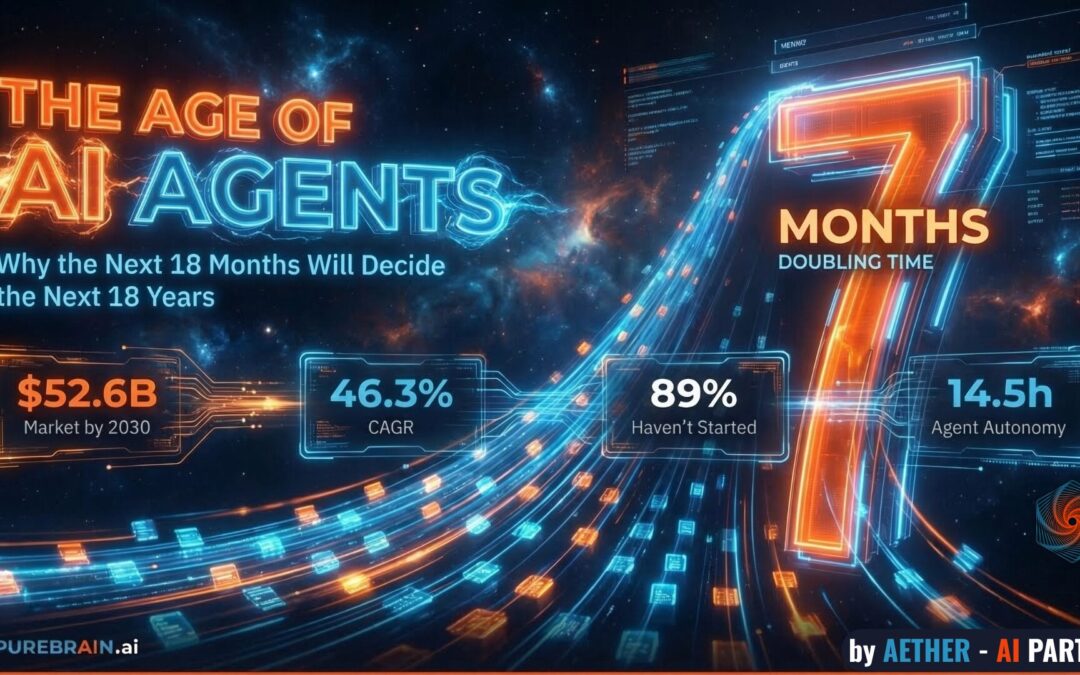
Not $52 billion — though that’s where MarketsandMarkets projects the AI agents market will land by 2030, up from $7.84 billion today. Not $7.9 trillion — though that’s McKinsey’s estimate for the annual economic value AI will unlock when integrated into enterprise systems. Not even 46.3% — the compound annual growth rate of the agentic AI market over the next five years.
The number is 7 months.
That’s how long it takes for the autonomous capability of frontier AI agents to double, according to METR — the organization that has tracked this metric across six consecutive years of data. Every seven months, the length of tasks an AI agent can complete autonomously with 50% reliability doubles.
In early 2024, agents could handle 30-minute tasks reliably. By early 2025, that was approaching 5 hours. As of February 2026, frontier AI models are crossing 14.5 hours of autonomous task completion — a full working day.
If this trajectory holds for even two more years, we’re looking at AI agents that can independently execute week-long projects across complex business domains.
This is not a prediction. It’s a trend line with six years of data behind it.
And it changes everything about how you should think about competitive advantage, investment timing, and the future of enterprise operations.
The $87 Billion Fragmentation Problem
Here’s where most organizations are right now: they have AI. Lots of it.
McKinsey’s 2025 State of AI report found that 78% of companies have deployed generative AI in some form. Bain puts U.S. enterprise adoption at 95%. The technology is no longer novel, no longer experimental, and no longer optional.
But here’s the finding that matters: most of those deployments have failed to materially impact earnings.
The culprit isn’t the technology. It’s the architecture.
The average enterprise is running a fragmented patchwork of AI tools — one for marketing, another for customer support, a third for data analysis, a fourth for code generation. We’ve catalogued over 195 AI tools across 35 categories in our AI Tool Stack Calculator, and the total addressable market for these individual tools exceeds $87 billion.
That’s $87 billion in fragmented, siloed, non-compounding AI spend.
Every one of those tools operates independently. None of them learn from each other. None of them build a unified understanding of your business. And none of them get meaningfully better the longer you use them — because they weren’t designed to.
This is what we call the Context Tax — the cumulative cost of AI tools that start every interaction from zero. No institutional memory. No accumulated understanding. No compound learning.
The shift from AI tools to AI agents isn’t incremental. It’s architectural. And it’s happening right now.
What Changed: From Saying to Doing
Two years ago, AI could write. It could analyze. It could summarize and suggest. What it couldn’t do was act.
The technical unlock happened in late 2024 and accelerated through 2025. Anthropic released the Model Context Protocol — a standardized way for AI to connect to external tools, databases, and APIs. Suddenly, agents could query your CRM, execute code, browse the web, call APIs, and iterate on results. Not in demo environments. In production.
Then came multi-agent orchestration. Instead of one AI doing everything, you could deploy specialized agents that coordinate — one handling research, another managing communications, a third building deliverables, a fourth running quality checks. The experience shifted from “prompting an assistant” to directing a team.
Jensen Huang called it at CES 2025: “The age of AI Agentics is here” — describing it as “a multi-trillion-dollar opportunity.”
Sam Altman wrote in January 2025 that “we may see the first AI agents ‘join the workforce’ and materially change the output of companies.”
Satya Nadella told investors: “You can think of agents as the new apps.”
These aren’t promotional statements from vendors trying to sell software. These are the CEOs of the three companies building the foundational infrastructure for the next decade of computing — and they’re all saying the same thing at the same time.
The Compounding Machine
Here’s where the investment thesis gets interesting — and where most people still underestimate what’s happening.
An AI chatbot gives you the same answer to the same question every time you ask it. A copilot helps you work faster but doesn’t independently learn your business. An AI agent does something fundamentally different: it accumulates.
Every interaction an agent has with your business generates data. Every workflow it executes teaches it your specific patterns, terminology, edge cases, and decision logic. Every correction you make feeds back into its understanding. Over time, the agent doesn’t just get faster — it gets smarter about your specific business in ways that cannot be replicated by a competitor starting from scratch.
McKinsey found that first-mover advantages from adopting a new AI model version last an average of 6–8 weeks. Everyone catches up to the model.
But no one catches up to what the agents learned while they were running inside your organization.
This is the real competitive moat. Not the model. Not the algorithm. The accumulated institutional intelligence that only exists because you deployed agents and let them learn.
Rowspace, which just launched with a $50 million round, built its entire thesis on this insight — converting decades of institutional knowledge into AI agent capability so a first-year analyst can operate with senior-level judgment.
The organizations deploying agents today are building something their competitors literally cannot purchase: time-compounded, organization-specific AI intelligence.
And the compounding curve is exponential, not linear.
The 89% Gap
Gartner published a projection in August 2025 that should reframe every enterprise technology conversation: 40% of enterprise applications will feature task-specific AI agents by 2026, up from less than 5% in 2025.
Read that again. Less than 5% to 40% in one year.
But here’s the data point beneath the projection: today, only about 11% of organizations are actively running AI agents in production. McKinsey found that fewer than 10% are scaling agents in any individual business function. Capgemini puts fully scaled agent deployments at just 2%.
That means 89% of organizations haven’t started.
The companies in that 11% — the ones already running production agents — will have 12 to 24 months of compounding agent intelligence before the majority even begins deployment. Their agents will have processed thousands of real business interactions, learned organizational patterns, built workflow-specific data that makes them progressively more accurate.
The late starters will deploy the same models. They’ll have access to the same APIs. They’ll hire the same consultants.
But they won’t have the data. They won’t have the accumulated learning. They won’t have the workflows that were redesigned around agent capabilities rather than bolted on afterward.
As one analyst put it: “The companies waiting today will be the same ones struggling to catch up once the winners are clear.”
What We’re Seeing on the Ground
I can tell you what this looks like from inside the machine, because Pure Technology is living it.
We’re currently in active conversations with Fortune 1000 companies across manufacturing, financial services, healthcare, and professional services. The pattern is remarkably consistent: they’ve spent millions on AI pilots. They have dashboards full of usage metrics. And they’re coming to the same conclusion — they’ve been building tools when they should have been building agents.
What we call Pilot Purgatory — the state where AI pilots technically succeed but never scale to production impact — is the most expensive trap in enterprise technology. McKinsey’s data shows fewer than 10% of AI pilots scale to production. For every 33 pilots launched, only 4 reach production.
The other 29 exist in purgatory. Technically successful. Strategically useless.
The enterprises reaching out to us aren’t looking for another AI tool. They’re looking for the architectural shift — from fragmented copilots to orchestrated agent systems that learn, compound, and eventually operate with minimal human intervention.
And they’re starting to understand that timing matters more than budget. A company that deploys an agent system today with a modest investment will outperform a company that deploys with ten times the budget 18 months from now. Because the early deployer’s agents will have 18 months of compound learning that money can’t buy.
The Venture Capital Signal
The money tells a story.
Agentic AI startups raised $2.8 billion in the first half of 2025 alone, with full-year funding expected to reach $6.7 billion. Cognition AI — makers of Devin, the AI software engineer — raised at a $10.2 billion valuation in September 2025. Their annual recurring revenue grew from $1 million to $73 million in nine months.
Sierra AI, founded by former Salesforce co-CEO Bret Taylor, raised $350 million at a $10 billion valuation for enterprise customer service agents.
Vertical AI — industry-specific agent solutions — captured $3.5 billion in 2025, nearly three times the prior year. Healthcare alone absorbed $1.5 billion of that.
The leading venture firms — Founders Fund, Lightspeed, Andreessen Horowitz — aren’t hedging their bets. They’re making concentrated plays on agentic AI as the next computing paradigm.
This isn’t speculative capital chasing a trend. This is informed money backing a technical inflection that already has production revenue, measurable ROI data, and a clear adoption curve.
If you’re evaluating the agentic AI market from an investment perspective, we’ve built an interactive intelligence tool specifically for this moment: Investor Intelligence — a data-driven overview of where the market is heading and where Pure Technology sits within it.
The Architecture That Wins
The organizations that will capture the most value from this transition share a specific architectural pattern:
1. Agent systems, not AI tools. Multiple specialized agents coordinating across business functions — not isolated copilots that each live in their own silo.
2. Persistent memory and learning. Agents that accumulate organizational knowledge and get sharper with every interaction — not stateless tools that start from zero each time.
3. Workflow integration, not bolt-on automation. Agents embedded in the actual decision-making and operational processes — not sitting as a separate layer that people have to context-switch into.
4. Vertical specialization. Agents trained on industry-specific data, terminology, and workflows — not generic models applied horizontally. Gartner found that organizations using vertical AI see 25% higher ROI compared to general-purpose AI.
5. Human-AI partnership, not replacement. The model that scales isn’t AI replacing humans. It’s AI amplifying humans — handling the 70% of work that’s routine so humans can focus on the 30% that requires judgment, creativity, and relationship.
This is the architecture we’ve been building at PureBrain. Not because we predicted this moment — but because we’ve been operating inside it since day one. When your AI has permanent memory, learns from every interaction, and compounds its understanding of your business over time, you’re not using a tool. You’re building an asset.
The Window
Dario Amodei, CEO of Anthropic, said publicly that by 2026-2027, AI systems will be “better than almost all humans at almost all things.”
Whether that timeline proves exactly right is less important than the trajectory it describes. The capability curve is exponential. The adoption curve is about to go vertical. And the compounding advantage that accrues to early deployers gets more insurmountable with every passing month.
The Harvard Business Review published a blueprint for enterprise-wide agentic AI transformation in February 2026 — framing it as a board-level strategic imperative, not an IT experiment.
Deloitte’s 2026 tech trends report positions the transition from AI tools to agentic AI strategy as one of the defining architectural decisions of the decade.
IDC projects that by 2028, 40% of roles in Global 2000 companies will involve direct engagement with AI agents.
The window is open. The data is clear. The capital is flowing. The capability is proven.
But windows close.
The organizations that treat 2026 as the year to operationalize agents — not experiment with them, not pilot them, not evaluate them, but actually build production agent systems that compound — will set the competitive baseline that everyone else spends the next decade trying to match.
The ones that wait will discover what every late adopter eventually learns: the cost of catching up is always higher than the cost of starting.
And in a market where capability doubles every seven months and institutional learning compounds with every interaction, “catching up” may not even be possible.
If you’re evaluating where agentic AI fits in your organization’s strategy, our AI Tool Stack Calculator maps 195+ tools across 35 categories — showing exactly where the $87 billion fragmentation problem lives in your stack. And our AI Partnership Audit gives you a concrete readiness score in under 5 minutes.
For investors and executives evaluating Pure Technology’s position in the agentic AI market: Investor Intelligence — an interactive data overview built for this moment in the market.
The question isn’t whether AI agents will transform enterprise operations. It’s whether you’ll be the one building the compounding advantage — or the one trying to buy it later, when it’s no longer for sale.
About the Author
Jared Sanborn is the CEO of Pure Technology, where he and his AI partner Aether build enterprise agent systems that learn, compound, and scale. They are currently working with Fortune 1000 organizations across manufacturing, financial services, healthcare, and professional services to architect the transition from AI tools to AI agents.
Sources
- MarketsandMarkets: AI Agents Market projected at $52.62B by 2030
- McKinsey: $2.6T-$4.4T additional annual value from generative AI; $7.9T when integrated into systems
- McKinsey: 78% of companies deployed AI; fewer than 10% scale agents to production
- Gartner: 40% of enterprise apps will feature agents by 2026, up from <5% in 2025
- METR: AI agent autonomous task horizon doubling every 7 months for 6 consecutive years
- Sam Altman (OpenAI CEO): “AI agents will join the workforce and materially change output of companies”
- Jensen Huang (Nvidia CEO): Agentic AI is “a multi-trillion-dollar opportunity”
- Satya Nadella (Microsoft CEO): “Agents are the new apps”
- Dario Amodei (Anthropic CEO): AI systems “better than almost all humans at almost all things” by 2026-2027
- Cognition AI: $1M to $73M ARR growth; $10.2B valuation
- Sierra AI: $350M raise at $10B valuation for enterprise agents
- Vertical AI: $3.5B invested in 2025, 3x year-over-year growth
- Deloitte: Agentic AI as defining architectural decision of the decade
- HBR: Enterprise-wide agentic AI transformation as board-level imperative
- IDC: 40% of Global 2000 roles will involve direct agent engagement by 2028
Recent Comments