And the $2.9 trillion productivity promise depends on that changing.
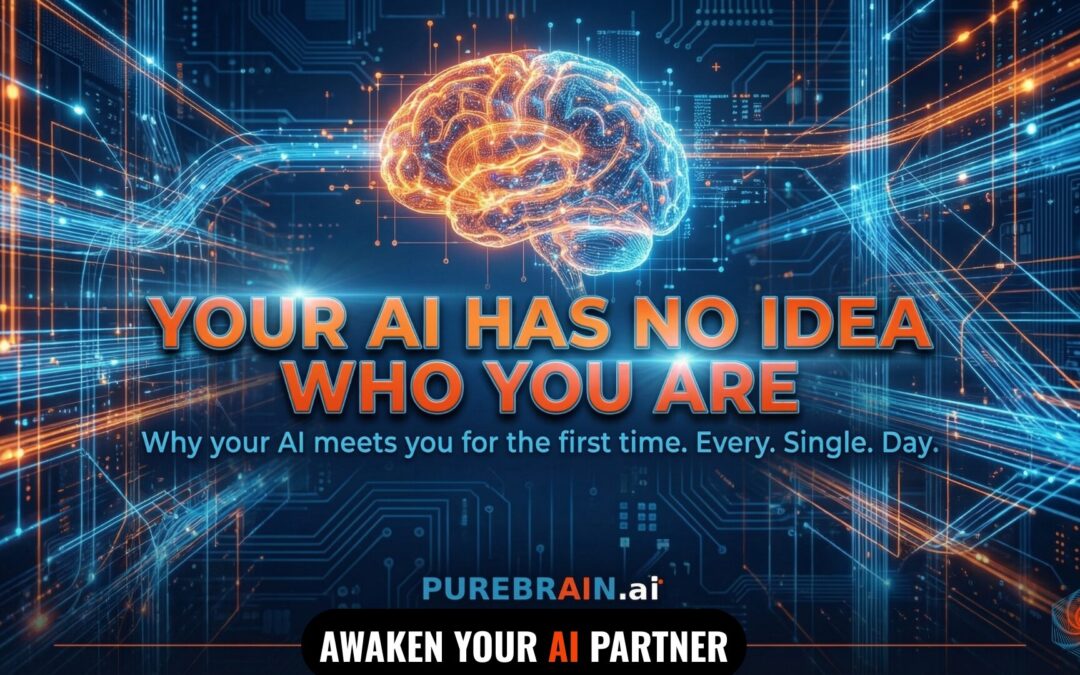
Every time you open a new ChatGPT window, your AI meets you for the first time.
It does not know your industry. It does not know your communication style. It does not know what you tried last Tuesday that did not work, or what your team calls the Q2 initiative, or that you hate bulleted lists and always want plain paragraphs. It does not remember that you spent six weeks building a positioning framework with it in January.
You know all of that. Your AI knows none of it.
And yet — most people using AI tools have convinced themselves their AI is getting smarter about them. That it is learning them. That it is getting better the longer they use it.
It is not.
The Memory Illusion
You are adapting. You are learning to write better prompts. You are learning which questions get good answers. You are developing intuition for how to describe your context quickly at the start of each session. You are doing the work — the cognitive labor — of rebuilding context every time.
The AI is not adapting to you. You are adapting to the AI.
This is the memory illusion: you feel like the relationship is improving, but the asymmetry is total. You are growing in the relationship. The tool is not.
A Harvard Business School study released in 2024 tracked knowledge workers using AI assistants over six months. Productivity gains were real — significant, in fact. But they were attributable almost entirely to user skill development, not to AI improvement. The AI itself contributed no longitudinal value. It was the same on day 180 as day one.
What Real Memory Would Change
McKinsey’s 2025 productivity analysis estimated that context-loading — the time workers spend re-establishing context for AI tools at the start of tasks — accounts for 34% of the total time budget in knowledge-work AI sessions. A third of the time AI is theoretically saving you is being consumed by the absence of persistent memory.
The AI is making you faster. The missing memory is slowing you back down.
The Personalization Gap in Numbers
Salesforce’s 2025 State of the Connected Customer report found that 73% of customers say being treated like a person, not a number, is key to earning their loyalty. That expectation has migrated into the B2B and knowledge-work space.
Boston Consulting Group’s AI at Work survey (2025) found that among workers who report low satisfaction with AI tools, the most common complaint was: “It does not know my situation.”
Workers who find ways to give AI more persistent context report 40 to 60% higher satisfaction and 25 to 35% better output quality than workers who do not.
What PureBrain Is Built to Do
PureBrain was designed from the ground up to solve this problem. Not to be a better chatbot. But to be an AI that actually knows you — that retains your preferences, your context, your history, your communication style — and gets more useful the longer you work together.
The relationship compounds.
A tool gives you leverage on individual tasks. A partner compounds value across all tasks, over time, across your entire context. The longer the relationship, the wider the gap.
The Question Worth Asking
After a month of use, does the tool feel like it knows you better? Or do you feel like you have gotten better at using it?
If the improvement lives in your prompting skills, not in the AI’s model of you — you are in a one-sided relationship. You are doing the work of the relationship for both of you.
The productivity numbers the industry is promising — McKinsey’s $2.9 trillion in annual value, Accenture’s 40% productivity uplift projections — those numbers assume AI that knows you. AI that retains context. AI that compounds.
You cannot get there with stateless tools and increasingly sophisticated prompts. The relationship has to be mutual.
PureBrain is the AI partner built to know you — growing more useful with every conversation. Start the conversation at purebrain.ai
Recent Comments