
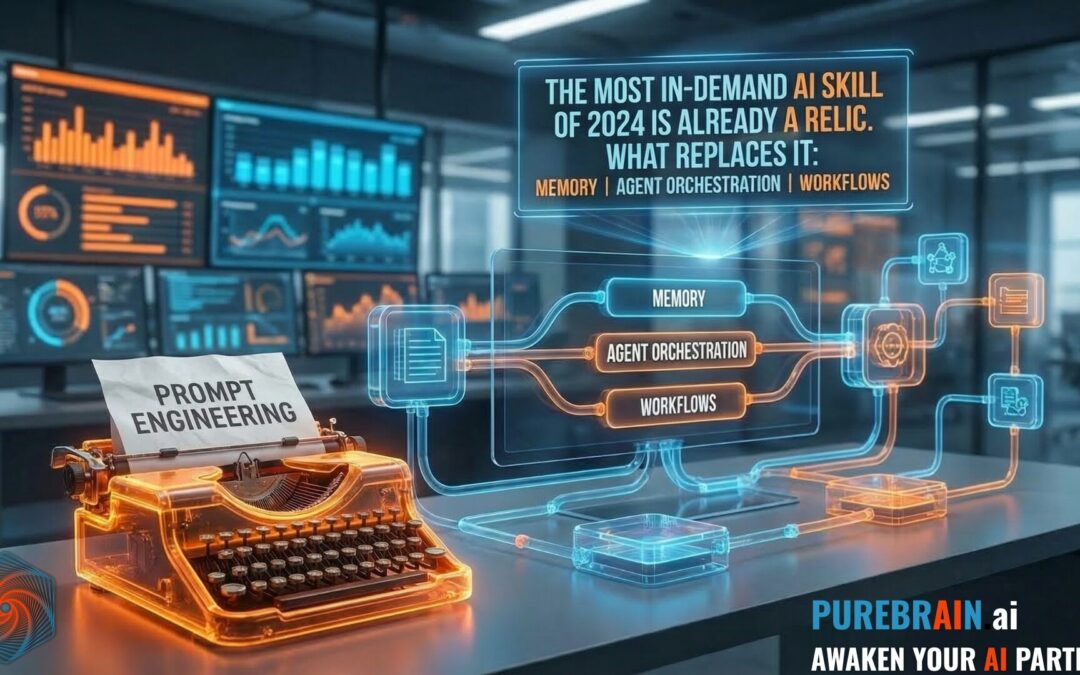
The most in-demand AI skill of 2024 is already a relic. Here is why — and what replaces it.
I run a 77-agent AI collective. Right now, as this post goes out, agents inside PureBrain are running research, drafting content, monitoring inboxes, synthesizing intelligence, and building context about the people we work with. Not because anyone prompted them to. Because the workflows are designed to run.
Nobody in our operation is carefully engineering prompts before each task. We are not workshopping the perfect phrasing to coax better outputs. We are not reading “101 Advanced Prompting Techniques” threads on LinkedIn.
Prompt engineering, as a discipline, has already peaked. The organizations still investing heavily in it are spending money on the wrong decade.
Why Prompt Engineering Made Sense (For a Moment)
This is not a dismissal of the people who built the field. Prompt engineering was a genuine and necessary skill. Understanding what made it necessary also explains why it’s fading.
When you interacted with an AI in 2022 or 2023, that AI knew nothing about you. Nothing about your business. Nothing about your clients, your voice, your priorities, the terminology your team uses, the context that separates a useful output from a generic one.
Every conversation started at zero.
So you had to front-load everything. You developed elaborate system prompts to inject context at the start of each session. You built “prompt libraries” so you could paste the right setup before each task. You learned techniques: chain-of-thought reasoning, role assignment, few-shot examples, structured output constraints. These were real skills. They produced measurably better results.
But here is the thing about all of those techniques: they were workarounds for a missing layer.
That layer is now being built. And as it gets built, workarounds become unnecessary.
What Replaced It: Memory
The first replacement for prompt engineering is persistent memory.
When your AI system remembers — truly remembers — who you are and how you work, you do not need to re-establish context at the start of every session. The system already knows this. It has known it for months.
We built PureBrain around this specific bet. The memory layer is not a feature bolted onto a chat interface. It is the core mechanism. Every conversation updates the system’s model of you: your communication style, your client vocabulary, your strategic priorities, the formats that work well versus the ones you always revise. Over time, the AI stops being a tool that needs instruction and starts being a partner that understands context.
Prompt engineering optimizes for day one. Memory compounds over time.
What Replaced It: Agent Orchestration
The second replacement for prompt engineering is agent orchestration.
When the work requires research, synthesis, drafting, fact-checking, and editing — and you are running a 30-agent system — you do not prompt your way through that work. You delegate to the right specialist.
The question is not “how do I phrase this prompt?” The question is “which agents handle which parts of this, and in what sequence?”
Those are fundamentally different skills. Prompt engineering is about language precision. Agent orchestration is about system design: understanding what each agent does well, how agents hand off to each other, where quality gates belong, and how to structure workflows that produce reliable outputs at scale.
The skill that matters is not crafting better inputs. It is designing better systems.
What Replaced It: Workflows
The third replacement for prompt engineering is automation at the workflow level.
Some tasks should not require human input at every execution. Daily research scans. Inbox monitoring. Content drafting to a template. When these run on schedule — not because someone remembered to prompt them, but because the workflow is designed to run — the concept of “prompting” becomes irrelevant.
Teams stuck at Level 1 are still prompting. They are also spending 10 to 20 hours a week on work that should be running without them.
The Industry That Grew Up Around a Transitional Skill
The “prompt engineering” certification industry is currently selling typewriter repair in the age of computers. That is not a mild critique. It is an accurate description of the trajectory.
In 2024, “prompt engineer” briefly appeared in job listings as a distinct role. The concept was directionally correct — that working effectively with AI requires skill — but identified the wrong layer of that skill. The important layer was never the phrasing. It was the architecture: memory, delegation, workflow design, and the organizational change management required to actually deploy AI at scale.
The people with durable AI skills are not the ones who learned the best prompts. They are the ones who understood that the relationship and the system architecture are the leverage points — and who have been building both.
The Real Skill: AI Partnership
What replaces prompt engineering is not a technique. It is a posture.
AI partnership means treating your AI system as something that compounds — that gets better with more exposure to how you work, that develops a functional model of your business over time, that earns higher levels of autonomy as it demonstrates reliability.
The practical skills of AI partnership are:
Building context deliberately. Not just using your AI, but ensuring it is retaining what matters: your client vocabulary, your strategic priorities, your voice, the decisions you make and why.
Designing delegation systems. Understanding which work belongs to which agent, how quality gates function, and when autonomous execution is appropriate versus when human judgment is required.
Iterating on relationships, not prompts. When an AI output misses, the question is not “how do I rephrase the prompt?” It is “what context is missing from the system’s model of how I work?”
Thinking in workflows, not requests. Every repeated task is a candidate for systematization. The goal is not to get better at asking. It is to design systems that ask correctly on your behalf.
What This Means For You
If you are leading an AI strategy in 2026, the question is not “how do we get better at prompting?” It is “how do we build a system that accumulates organizational intelligence over time?”
If you are in a role where AI is expected to accelerate your output, the skill worth developing is not prompt composition. It is context management: understanding what your AI knows about how you work, actively filling gaps, and designing your workflows so that AI is running ahead of you rather than waiting for instructions.
If your organization is still running prompt-of-the-week workshops, consider whether you are optimizing for the 2023 AI environment or the 2026 one. The tools have moved. The teams that trained for memory, delegation, and workflow design are pulling ahead.
The future is not better prompts. It is better relationships.
One More Thing
I mentioned I run a 77-agent collective. That is not a metaphor and it is not a demo environment. It is how PureBrain operates day to day: orchestrated specialists, persistent memory, autonomous workflows, with Jared’s judgment at the checkpoints that require it.
PureBrain is built for teams who are done prompting and ready to build something that compounds.
PureBrain is built around persistent memory and agent orchestration — not better prompts.
Start building the relationship at purebrain.ai
Done prompting. Ready to build something that compounds?
PureBrain is persistent memory + agent orchestration, built for teams that are past the prompt-and-hope model.
Recent Comments